
AI Services
AI
Integration
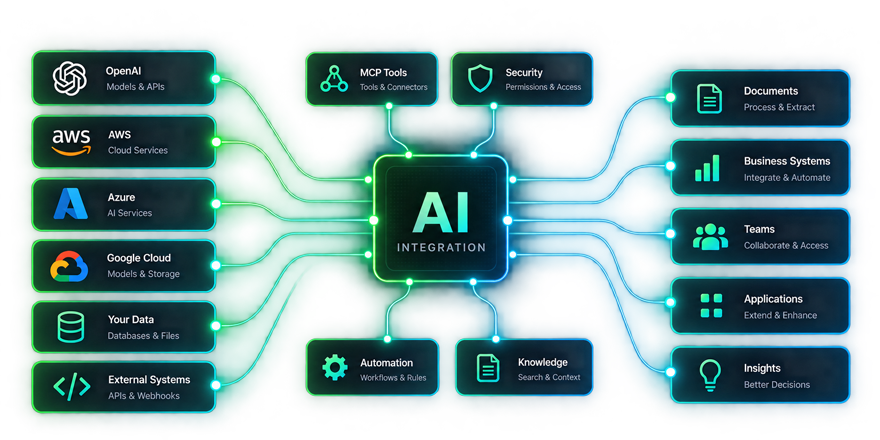
Connect AI to the software, data and workflows your business already uses through secure APIs, MCP tools and custom integrations instead of creating another isolated system.
- Software Engineering Since 2004
- Custom Built Solutions
- Full Stack Development
- Private + Cloud AI
Add AI to Existing Systems
Put AI Inside the Software and Workflows Your Team Already Uses.
Many organizations do not need an entirely new AI application. They need useful AI capabilities added to the systems, data and workflows already running the business.
Seed integrates AI into existing software, websites, databases and business processes so users can search, summarize, classify, extract, draft, analyze and automate work without moving everything into another standalone platform. We can connect those capabilities through traditional APIs, MCP tools or custom application services depending on the system.
The integration can be a focused feature inside one application or part of a broader modernization, automation or AI strategy that connects multiple systems and data sources.
AI Integration Capabilities
Connect AI to the Systems, Data
and Tools That Matter.
We integrate cloud AI services, private models and hybrid AI architectures into new and existing applications with deliberate controls around data access, permissions and business rules. Integrations can use APIs, MCP or internal services depending on the system and use case.
Software
Existing Software Integration
Add AI directly into business applications, portals, websites and internal systems your users already understand.
Database
Database Integration
Give AI controlled access to structured business information so it can support search, analysis, summaries and application workflows.
Knowledge
Private Knowledge Integration
Connect approved documents, files and knowledge bases so AI responses can be grounded in information specific to your organization.
API
AI API Integration
Connect commercial AI services, hosted models and business platforms through secure APIs and controlled server-side workflows.
Private
Private Model Integration
Connect AI models running inside infrastructure controlled by your organization when privacy, control or deployment requirements make private AI appropriate.
MCP
MCP Integration
Use Model Context Protocol to connect compatible AI clients and agents to approved tools, resources and business systems through a structured integration layer.
Integration Patterns
Use AI Where It Reduces Friction
Instead of Creating More of It.
The best integration keeps users inside familiar systems and gives AI only the information, tools and permissions required for the task, whether access is provided through APIs, MCP or internal services.
01
Assist
Help users draft, summarize, analyze, search and make decisions while keeping a person in control of the final action.
02
Retrieve
Search approved documents, databases and business knowledge and return relevant information in a usable format.
03
Extract
Turn documents, emails, messages and other unstructured content into structured data that business software can use.
04
Automate
Use AI as one controlled step inside a larger workflow that can include APIs, MCP tools, validation, business rules, approvals and system actions.
AI + Integration Engineering
The Integration Around the Model Matters
as Much as the Model Itself.
Production AI usually needs more than a model connection. It needs authentication, application logic, business rules, logging, error handling, permissions and reliable connections to APIs, MCP tools and the systems around it.
Architecture
Existing Systems
Integrate AI without unnecessarily replacing the software and data infrastructure that already supports the business.
Context
Business Data
Give the model access to approved records, documents and application context required for each task.
Actions
APIs, MCP and Tools
Allow AI workflows to retrieve information, call APIs, use approved MCP tools and perform controlled actions in connected systems.
Security
Permissions and Boundaries
Control which users, applications, AI clients and agents can access specific information, tools and business functions.
Our Process
Integrate Carefully Around Data, Permissions, Tools and Workflow.
We start by defining where AI creates measurable value, then design the model, API and MCP integration architecture around that requirement.
01
Select the Use Case
Identify where AI can improve an existing application, workflow or business process.
02
Review Data and Access
Determine what information and tools the AI needs, where they live and which users or agents should be allowed to access them.
03
Choose the Model Strategy
Select cloud, private or hybrid AI based on capability, privacy, performance, control and infrastructure requirements.
04
Build the Integration
Connect the model to the application, data, APIs, MCP tools and user interface.
05
Test and Govern
Evaluate output quality, permissions, failure cases, logging and operational controls before expanding the solution.
Software Engineering Foundation
AI Integration Backed by
Full Stack Software Development.
Seed approaches AI as part of a larger software system. We combine models with applications, databases, APIs, MCP connections, authentication, business rules and workflow automation so AI can become a useful part of production software rather than another disconnected experiment.
Full Stack
Application + AI Development
Flexible
Private, Cloud or Hybrid AI
Integrated
Data, APIs, MCP and Business Systems
Frequently Asked Questions
AI Integration Questions
Yes. AI can often be added to existing applications through custom development, APIs, databases, internal services or other supported integration methods.
Yes. Approved documents and knowledge sources can be connected to AI search and retrieval systems with access controls appropriate to the application.
Yes. Private models can be used when privacy, data control, network requirements or deployment preferences make private AI a better fit. Hybrid architectures can also combine private and cloud models.
Yes. AI can be connected to controlled APIs and MCP tools that allow it to retrieve information or perform approved actions based on defined permissions and business rules.
Yes. A single AI workflow can work across databases, APIs, MCP tools, document systems and other business applications when appropriate integration methods are available.
Start a Project
Want AI Connected to the Systems Your Team Already Uses?
Show us the applications, data and workflows you want to connect. We can help define the right model strategy, API and MCP architecture, permissions and controls required to put AI into production.